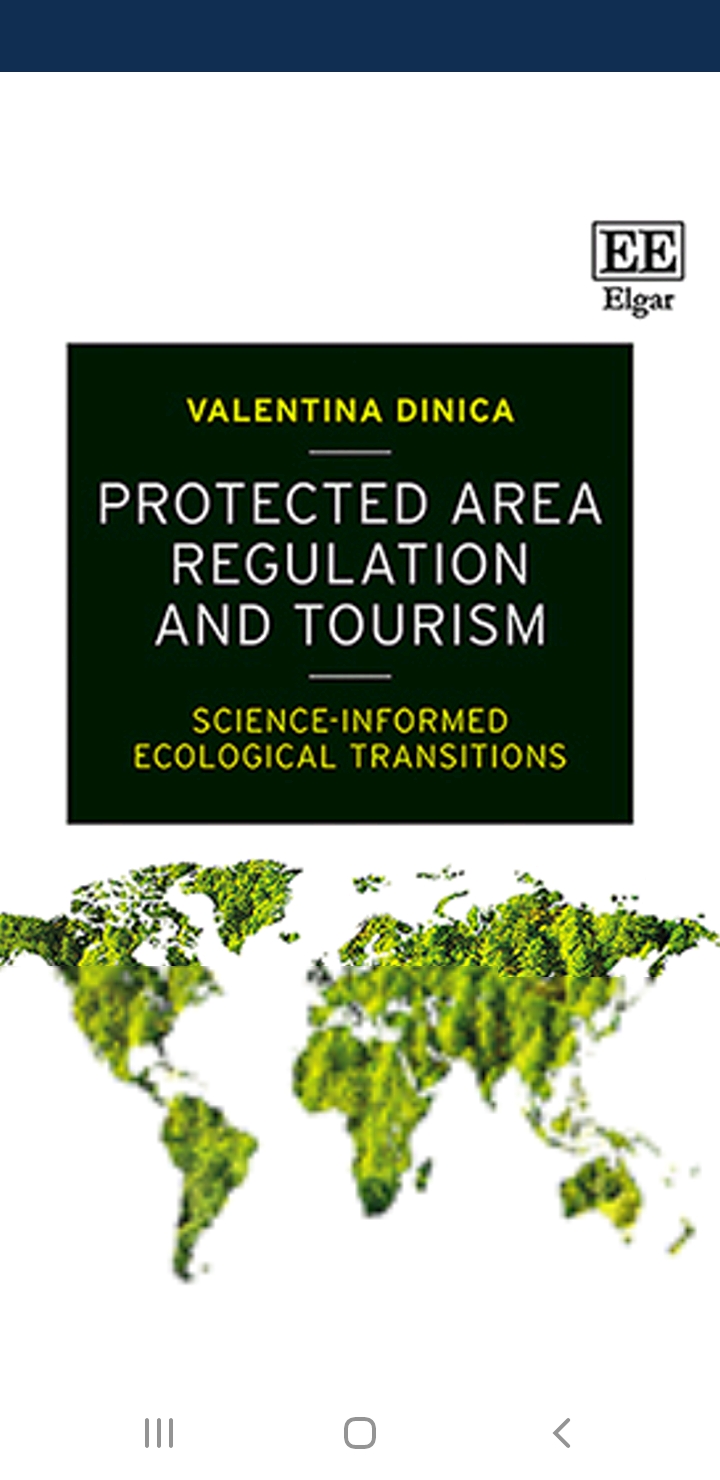


Protected Areas have seldom been systematically analysed from the standpoint of legal and policy perspectives, and the alignment of regulatory protections with the Area's ecological characteristics and protection needs. In this recent book, I examine the evolution of ecology and how scientific advances may enable the redesign of Protected Areas (PA), guided by area-specific ecological values and objectives. I argue that transitions towards science-informed integrated PA systems could contribute to safeguarding the persistence of biodiversity and socio-ecological systems.
The book proposes a conceptual framework, to integrate the ecological and tourism aspects of PA regulation. This can assist decision-makers to develop contextually effective regulatory instruments that avoid over-/under-regulating tourism, given the PA’s ecological profiles.
The framework is applied to comparatively evaluate the ecological representativeness and regulations of PA networks in New Zealand, Tasmania and Hawaii. The empirical chapters also discuss gaps and (mis-)alignments between ecology and tourism regulations, displaying outdated scientific paradigms. The book proposes a new approach to classifying PAs, to better balance human–nature relationships. This book will be of interest to students and academics in public policy, law, ecology, environmental studies, sustainability sciences, tourism studies, political science and history of science.
CRITICAL ACCLAIM
This book provides a unique and valuable contribution in the important area of the regulation of Protected Area management, including tourism. It adopts an historical view on the creation and management of protected areas, in order to understand the philosophies and attitudes towards these societal creations. It applies a broad framework to analyze the current regulatory regime in three example areas: New Zealand, Tasmania and Hawaii. This book makes a unique case of moving from ecological values to regulation. The book takes a global view with comprehensive reviews of relevant global conventions, treaties and policies and their possible impacts on management and regulation. This book should be useful to anyone involved in understanding the development and application of values into Protected Area laws and regulations.’
– Paul F. J. Eagles, University of Waterloo, Canada
‘The development and application of the SERPAT framework introduced in this timely book provides parties with a rigorous approach for managing Protected Areas. In stressing the proportionality principle – that policy responses must be effective but reasonable – the book provides a realistic guide for policies designed to protect ecological values while enabling human-centric enjoyment of nature.’
– Arthur Grimes, Victoria University of Wellington, New Zealand
Edward Elgar links
https://www.elgaronline.com/monobook/9781839107078.xml
https://www.e-elgar.com/shop/gbp/protected-area-regulation-and-tourism-9781839107078.html
Youtube link to summary https://youtu.be/9czodF5Ef70?feature=shared
Video by Victoria University of Welllington, New Zealand
https://youtu.be/0vzzkXtgzJA?si=Vr4DzaGkMHBzbo3T