

Learning for Life: Co-Creating Educational Strategies for a Living Planet
Learning for Life: Co-Creating Educational Strategies for a Living Planet is a dynamic 3-hour online training designed for educators, conservation practitioners, policymakers, and youth leaders seeking to align learning with global biodiversity goals.
Through interactive discussion, real-world examples, and collaborative activities, participants will explore practical ways to integrate biodiversity into formal, non-formal, and community learning spaces—linking knowledge, values, and action for a nature-positive future.
Join us to discover how education can drive meaningful behaviour change, strengthen community stewardship, and support implementation of the Global Biodiversity Framework. Leave with concrete ideas, shared tools, and renewed inspiration to help shape learning that sustains life on Earth.
Two trainings will be offered in March, both are free and open to all educators, practitioners, and policymakers working at the interface of education and biodiversity.
- Register for Session 1 on Tuesday March 10: 8:00 to 11:00 UTC
Register for Session 2 Wednesday March 11: 14:00 - 17:00 UTC
Both sessions are limited to 50 registrants, as trainings will be interactive and utilize facilitated breakout rooms. Register soon to reserve your spot.
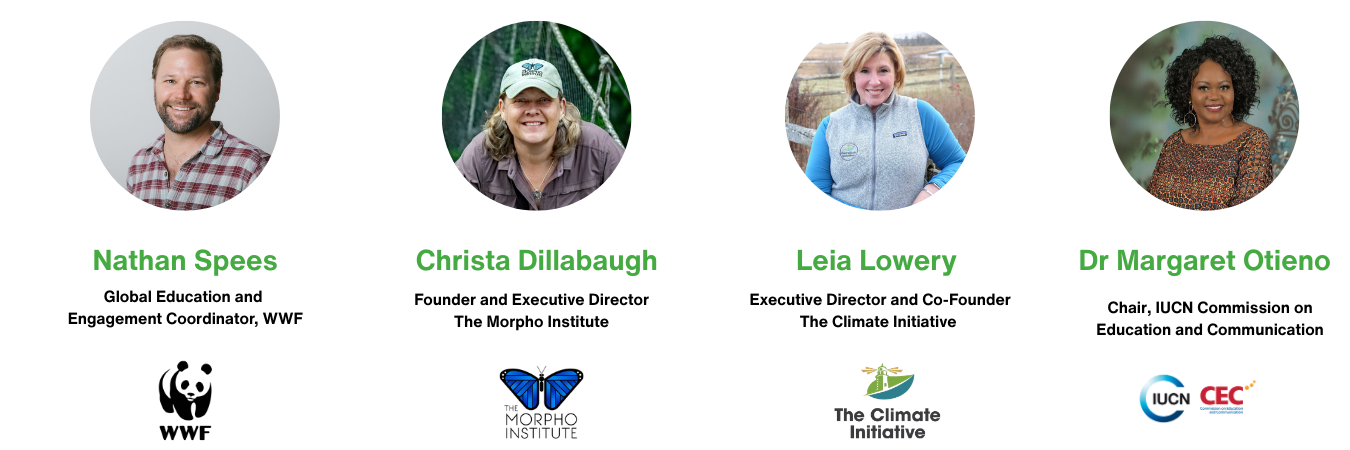
Expert hosts and facilitators for the March 11th Session include:
Nathan Spees, WWF Global Education and Engagement Coordinator, took on the global coordination role in 2022 after managing WWF Austria's Youth Empowerment Program from 2010-2022. In 2023, he led a co-design process to create WWF's global education and engagement strategy “Together for Action 2030.” In 2024, he was lead author of the "Learning for Life: Mobilizing Education for the Global Biodiversity Framework" guidance document (2024) on supporting the Global Biodiversity Framework’s implementation through education and engagement. As global coordinator, his responsibilities include developing and implementing the global strategy, overseeing program development, fundraising and collaboration across the network and with partners.
Christa Dillabaugh is the Founder and Executive Director of the Morpho Institute, a nonprofit advancing biodiversity conservation through inquiry-driven education and long-term partnerships in the Peruvian Amazon. She leads programs that connect U.S. educators with scientists, Indigenous partners, and local communities, translating classroom learning into meaningful conservation action. Prior to founding Morpho, Christa coordinated student and university field programs in the Amazon and launched Amazon Rainforest Workshops, LLC, beginning with expeditions for her own students from Bexley, Ohio. She has also worked as a freelance science consultant for Pearson Education and Discovery Communications, contributing to STEM curriculum and educator professional development.
Leia Lowery is The Climate Initiative’s Executive Director and Co-Founder with over twenty five years of experience in education, curriculum development and community engagement. Her passion is developing place and community-based programs to inspire community action and influence youth impact. An award-winning speaker and trainer, Leia hopes to empower communities to build a more vibrant and equitable future.
Dr Margaret Otieno is the Chair of the IUCN Commission on Education and Communication. Dr Otieno is also the CEO/National Coordinator of Wildlife Clubs of Kenya, a national NGO targeting the youth and communities with Conservation Education. Margaret is also a board member of Worldlife Kenya, African Fund for Endangered Wildlife, Elsa Conservation Trust and is Deputy Chair for the Kenya Steering Committee (IUCN). A holder of a PhD in Climate Change and Education for Sustainable Development and an MSc in Environment and Development, she is the 2020 winner of the 2020 International Brandwein Medal award. Margaret is a passionate hands-on environmental education professional and is driven by the belief that sustained education from grassroots to leadership levels is the single most important element in improved environmental protection and conservation. Through Africa wide workshops, WCK has stimulated a continental wildlife clubs movement. It has also helped spawn clubs in Asia, Latin America, and elsewhere in the developing world. In over 50 years, WCK has helped educate over 1,000,000 young Kenyans and placed many of them in positions of influence.