


Dear CEM members,
We are excited to invite you to our next CEM Dialogue:
Indian Forests and Forest Degradation Prevention Through Forest Landscape Restoration
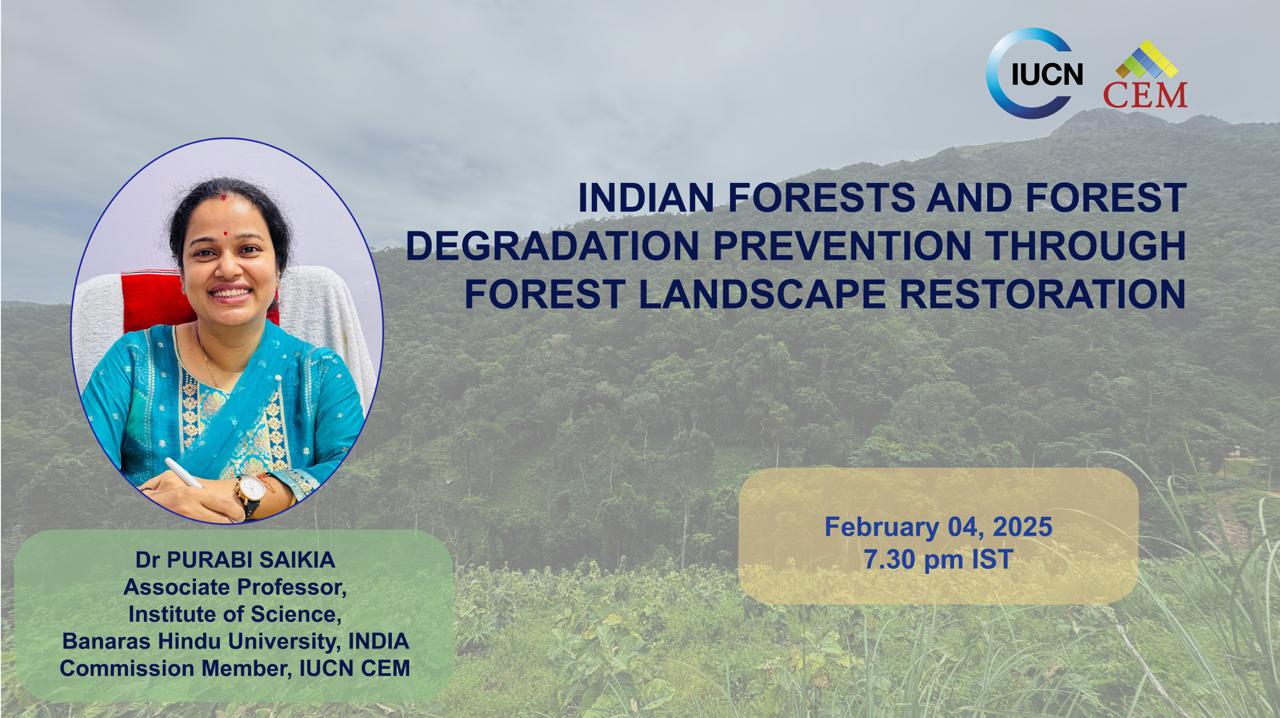
Date: Tuesday, 4 February 2025
Time: 7:30 pm IST
Description
Forests are the primary repositories of terrestrial biodiversity, accounting for approximately 80% of such biodiversity. In India, they constitute the second-largest land-use after agriculture. More than 40% of the Indian forests are degraded and under-stocked and 70% have lost their natural regeneration potential. Forest degradation is a natural eco-disaster affecting the economy and ecology at local to global scale. Factors responsible for the acceleration of forest degradation include population growth, forest land conversion for agriculture, industry, power projects, irrigation, roads, urbanization, private encroachments, improper forest management, etc. The continuous degradation of natural forests leads to drought, flood, disturbance in nutrient cycling, increasing atmospheric CO2, soil erosion, loss of biodiversity, etc. A positive forest cover change in recent years became possible because of better conservation and management interventions by the Indian government through afforestation, community participation for protection of plantation areas, and expansions of trees outside natural forests. Forest landscape restoration aims in enhancing the ecological integrity of deforested or degraded landscapes and also to improve human well-being using nature-based solutions such as plantation, agroforestry, erosion control, and natural forest regeneration. There are different International as well as Indian policies formulated to restore degraded forests like Indian Collaborative Forest Landscape Restoration Program with US Forest Service 2009, Bonn Challenge 2011, Joint Forests Management, etc.
Speaker:
Dr Purabi Saikia has been working as an Associate Professor in the Department of Botany, Institute of Science, Banaras Hindu University, Varanasi, since June 2024. She is working in plant ecology especially phytosociology, conservation of rare, endangered plant species, plant productivity estimation, plant invasions, and ecological niche modelling in Indian forests. She is the recipient of the prestigious Rashtriya Vigyan Puraskar: Vigyan Yuva, Shanti Swarup Bhatnagar 2024 in Environmental Science from the Ministry of Science and Technology, Govt. of India and several other awards of national repute. She has published ~67 journal articles in different Scopus/ WoS and UGC-care listed journals, 03 edited/ co-authored books, 01 policy document with IUCN, and ~56 chapters in edited book volumes.